Short answer: Most US 10th graders take Geometry, or Integrated Math II at schools using an integrated pathway. The core skills are writing proofs, proving triangles congruent or similar, right-triangle trigonometry, coordinate geometry, circle relationships, and area and volume. Accelerated students may take Algebra 2 instead, so placement varies by school.
For many students, 10th grade is the first time math asks “why” instead of “what.” That shift trips up strong Algebra 1 students more often than parents expect.
Key points
- Usually Geometry: Geometry is the typical 10th grade course in the traditional Algebra 1, Geometry, Algebra 2 sequence.
- Integrated Math II: Combines quadratics with similarity, right-triangle trig, circles and probability.
- Proofs stack up: Each theorem builds on the last, so formal proof is the biggest new demand of the year.
- Algebra still matters: Geometry uses solving equations, slope and the distance formula constantly.
- PSAT year: Many sophomores take the PSAT/NMSQT or PSAT 10, which include geometry and trigonometry.
- Bridge to calculus: Similarity and right-triangle trig lead directly to precalculus, calculus and physics.
What math do 10th graders take?
The Common Core’s model course guidance describes a traditional pathway (Algebra I, Geometry, Algebra II) and an integrated pathway (Mathematics I, II, III) (Common Core Appendix A: model course pathways). Which course a sophomore takes depends on the school and on middle school placement.
| Student’s path | Typical 10th grade course | Main focus |
|---|---|---|
| Algebra 1 in 9th grade | Geometry | Proof, congruence, similarity, trig, circles, volume |
| Integrated pathway | Math II | Quadratics, similarity and right-triangle trig, circles, probability |
| Algebra 1 in 8th grade | Algebra 2 | Polynomials, rational and exponential functions, logarithms |
If your student is still in Algebra 1, start with our 9th grade math essentials guide. The rest of this article focuses on Geometry, the most common 10th grade course.
What topics are covered in 10th grade Geometry?
The Common Core High School Geometry standards are grouped into six domains. A typical course covers them in roughly this order.
| Unit | What students learn | Key skill to master |
|---|---|---|
| Congruence and transformations | Translations, reflections, rotations; proofs about lines, angles, triangles and parallelograms | Write a two-column proof with a reason for every step |
| Similarity | Dilations, scale factor, similar triangle criteria | Set up and solve proportions from similar triangles |
| Right triangles and trig | Pythagorean theorem, sine, cosine, tangent | Find a missing side or angle in a right triangle |
| Coordinate geometry | Slope criteria for parallel and perpendicular lines, distance, midpoint | Prove a shape’s properties using coordinates |
| Circles | Inscribed and central angles, chords, tangents, arc length, sector area, circle equations | Relate an inscribed angle to its arc |
| Measurement and 3D | Volume of cylinders, pyramids, cones and spheres; cross sections | Choose the right formula and keep units consistent |
Why does Geometry feel so different from Algebra?
Algebra rewards following a procedure. Geometry proofs ask students to build the procedure themselves, starting from given facts and justifying each step with a definition, postulate or theorem.
Our tutors’ curriculum notes describe Geometry as starting “as small as possible.” The course begins with the definitions of a point, a line and a plane, and every theorem after that builds directly on earlier ones.
- Basic terms: point, line, plane, segment, angle.
- Postulates and early theorems, such as vertical angles being congruent.
- Parallel-line angle pairs and triangle angle sums.
- Triangle congruence and similarity criteria.
- Proofs about parallelograms, circles and other figures that use all of the above.
Because the proofs stack across the whole year, the strategies feel different from anything students have seen before. The fix is not more memorization: it is learning a small set of reasons well and practicing how to chain them.
Tutor tip: Keep a running list of every definition, postulate and theorem in the order your class covers them. When a later proof stalls, the missing reason is almost always on that list.
Worked example: a short proof
Given: M is the midpoint of segment AB and of segment CD. Prove: triangle AMC is congruent to triangle BMD.
- AM = MB. Reason: definition of midpoint.
- CM = MD. Reason: definition of midpoint.
- Angle AMC ≅ angle BMD. Reason: vertical angles are congruent.
- Triangle AMC ≅ triangle BMD. Reason: SAS (two sides and the included angle).
What are the key 10th grade math skills, with examples?
Triangle congruence and similarity
- Congruence: SSS, SAS, ASA, AAS, and HL for right triangles.
- Similarity: AA, SSS similarity (all three side ratios equal), and SAS similarity (two side ratios equal and the included angle congruent).
- Not valid: SSA does not prove congruence, and AAA proves only similarity.
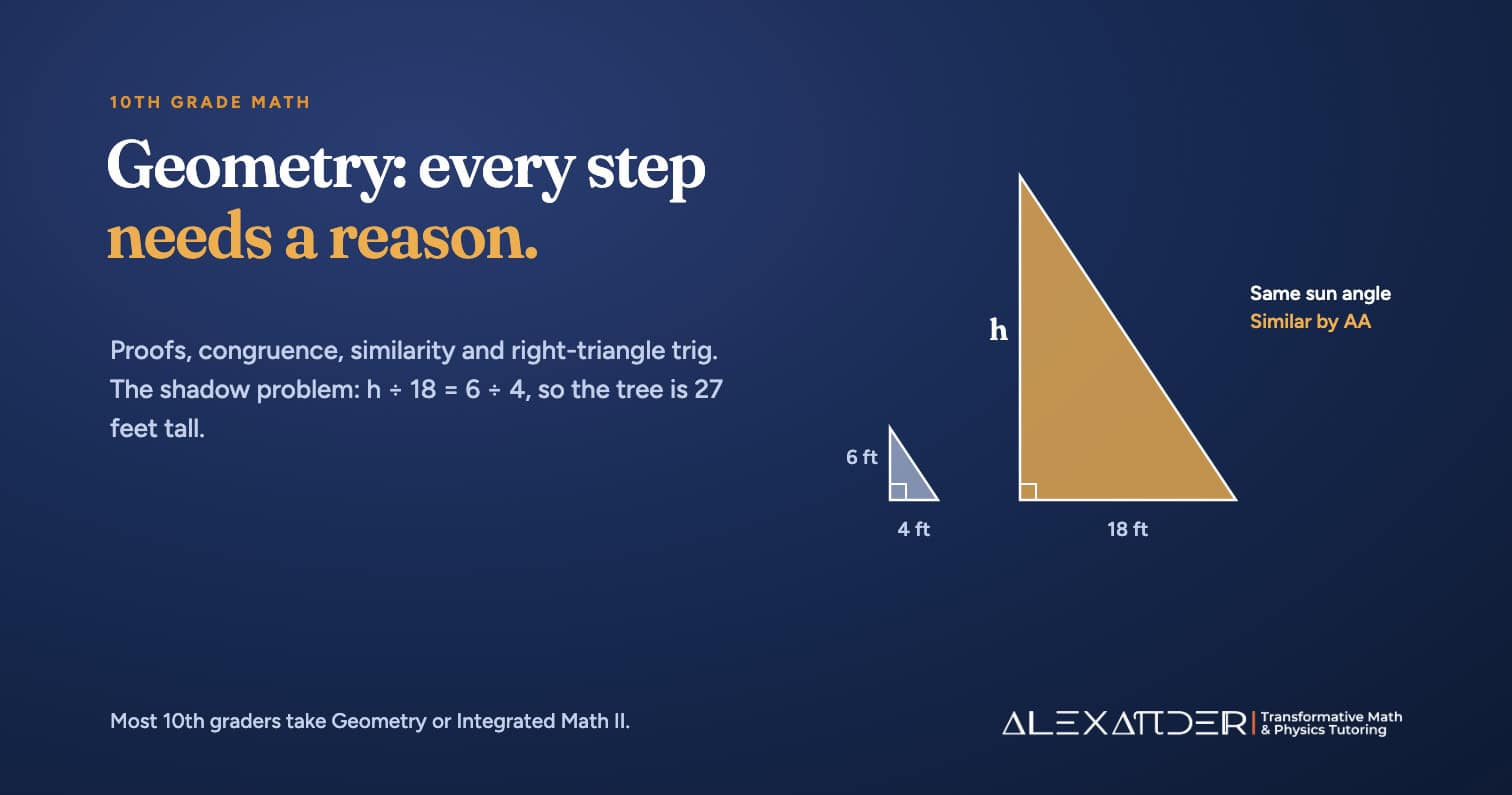
Example: a 6-foot person casts a 4-foot shadow while a tree casts an 18-foot shadow. The triangles are similar (AA), so h ÷ 18 = 6 ÷ 4, and h = 27 feet.
Our post on triangle congruence vs. similarity goes deeper.
Right-triangle trigonometry
For an acute angle θ in a right triangle:
sin θ = opposite ÷ hypotenuse, cos θ = adjacent ÷ hypotenuse, tan θ = opposite ÷ adjacent
Example: a 12-foot ladder makes a 70° angle with the ground. Height reached = 12 × sin 70° ≈ 12 × 0.940 ≈ 11.3 feet. Make sure the calculator is in degree mode.
Stuck on proofs?
Proof writing is a skill that improves fastest with someone checking each step’s reasoning in real time. One-on-one sessions can turn a confused Geometry student into a confident one within a unit or two.
Book a risk-free first lesson →
Or explore our geometry tutoring.
Coordinate geometry
- Parallel lines have equal slopes. Perpendicular lines have slopes that are negative reciprocals: a line with slope 2/3 is perpendicular to one with slope −3/2.
- Distance from (1, 2) to (7, 10): √((7 − 1)² + (10 − 2)²) = √(36 + 64) = √100 = 10.
- Midpoint of the same segment: ((1 + 7) ÷ 2, (2 + 10) ÷ 2) = (4, 6).
Circles
- An inscribed angle is half its intercepted arc. If the arc measures 80°, the inscribed angle is 40°.
- A tangent line is perpendicular to the radius at the point of tangency.
- Arc length for radius 9 and central angle 80°: (80 ÷ 360) × 2π × 9 = 4π ≈ 12.57.
- Completing the square finds a circle’s center and radius: x² + y² − 6x + 4y − 12 = 0 becomes (x − 3)² + (y + 2)² = 25, so the center is (3, −2) and the radius is 5.
Tutor tip: Our SAT tutors find that geometry is the rustiest topic by the time students sit the SAT, because later courses rarely reinforce it. Circle theorems, tangent and chord relationships and transversal angle pairs all come back, so keep your 10th grade notes.
Volume
A cylinder with radius 3 and height 8 has volume π × 3² × 8 = 72π. A cone with the same radius and height has one third of that: 24π ≈ 75.4 cubic units.
What are the most common 10th grade math mistakes?
The fastest way to improve in Geometry is to study your own errors, not just collect correct answers.
“Too many students never learn to find their own mistakes. Error analysis is essential to growth.”
Jake Gerhardt, Alexander Tutoring math tutor
Watch for these common errors:
- Using SSA or AAA to prove congruence. Neither works.
- Circular proofs. Using the statement you are trying to prove as one of your reasons.
- Mixing up opposite and adjacent. They depend on which angle you are working from.
- Calculator in radian mode. Geometry problems are almost always in degrees.
- Scaling area and volume like length. If lengths scale by k, area scales by k² and volume by k³.
- Forgetting the 1/3 in cone and pyramid volume.
- Perpendicular slope sign errors. Flip the fraction and change the sign.
Tutor tip: On every returned quiz, find the exact step where each wrong answer went off track and name the error type. Patterns show up quickly, and a repeated error is a fixable habit.
See the 5 most common geometry mistakes for fixes and practice ideas.
What should 10th graders know about the PSAT?
College Board describes the PSAT/NMSQT as designed for 10th and 11th graders, and the PSAT 10 as a spring test for 10th graders (College Board PSAT FAQ).
- 44 PSAT/NMSQT math questions
- 2 math modules
- 35 min per math module
- 6 Common Core Geometry domains
The math section covers algebra, advanced math, problem-solving and data analysis, and geometry and trigonometry, with a calculator allowed throughout (PSAT/NMSQT math section).
For most students, National Merit qualification is based on the junior-year PSAT/NMSQT, so a sophomore score is best used as practice and a diagnostic. To interpret a 10th grade result, read what is a good PSAT score for a sophomore.
How does 10th grade math set up 11th and 12th grade?
- Algebra 2: quadratics return in depth, and coordinate skills support graphing polynomial, rational and exponential functions.
- Precalculus: right-triangle trig extends to the unit circle and trig functions of any angle.
- Calculus and physics: similar triangles, trig and volume formulas reappear in vectors, related rates and optimization. Our 12th grade math guide shows where this leads.
- College: the habit of justifying each step is the same habit college math demands. See preparing for college math.
Tutor tip: Algebra 2 is mostly an extension of Algebra 1, and a Geometry year can leave those skills rusty. Our tutors highly recommend an Algebra 1 review the summer before Algebra 2: factoring, exponent rules, linear equations and graphing.
Tutor-written guide · PDF
Tips for Performing Well During STEM Exams
The game plan our tutors give students before a big math or science test. Enter your name and email and the guide opens right away.
- The night-before routine that beats cramming
- A first-five-minutes plan: formula dump, read-through, quick wins
- Halfway and 10-minute checkpoints so time never runs out
- Calm-down steps for test anxiety you can use mid-exam
Frequently asked questions
What math do most 10th graders take?
Most US 10th graders take Geometry, or Integrated Math II at schools using an integrated pathway. Students who took Algebra 1 in 8th grade often take Algebra 2 in 10th grade.
Is Geometry harder than Algebra 1?
Geometry is different rather than strictly harder: it emphasizes visual reasoning and proof instead of procedures. Some students who found Algebra 1 easy struggle with proofs at first, while some who struggled with algebra find Geometry more intuitive.
Do you need algebra for Geometry?
Yes. Geometry problems regularly require solving linear and quadratic equations, using slope, and applying the distance and midpoint formulas, so weak Algebra 1 skills show up quickly.
What is SOH CAH TOA?
SOH CAH TOA is a memory aid for right-triangle trig: sine is opposite over hypotenuse, cosine is adjacent over hypotenuse, and tangent is opposite over adjacent. It is usually introduced in Geometry or Integrated Math II.
Which triangle congruence shortcuts are valid?
SSS, SAS, ASA and AAS prove two triangles congruent, and HL works for right triangles. SSA and AAA do not prove congruence.
Should my 10th grader take the PSAT?
Many schools offer the PSAT/NMSQT or PSAT 10 to sophomores, and taking one is useful practice and a diagnostic for the SAT. National Merit qualification for most students depends on the junior-year PSAT/NMSQT, not the sophomore test.
What comes after 10th grade Geometry?
In the traditional sequence, Algebra 2 usually follows Geometry in 11th grade, then precalculus or statistics in 12th grade. Because Algebra 2 builds heavily on Algebra 1, a summer Algebra 1 review before 11th grade is a smart step.
Make 10th grade math the year it clicks
Our tutors are working mathematicians, scientists and engineers who teach one-on-one, online. Your first lesson is risk-free. Explore geometry tutoring or meet our tutors.
Get in touch → We respond within 30 minutes.
Author

Want Jake as your tutor?
Jake’s schedule is full. Join the waitlist and we’ll reach out the moment a spot opens. Meet Jake