Short answer: Since the University of California stopped using SAT and ACT scores in 2020, grades have carried more weight and become less reliable. Readiness for college math has dropped sharply. AI makes it worse: it can do a student’s homework, but it can’t learn the math for them, and the exams show it.
At San Francisco’s Mission High School, a student recently had a better chance of being admitted to UC Berkeley (44.7%, the highest rate of any public high school in California with more than 50 applicants) than of testing proficient in math (6%). That gap is a sign of a larger problem. Standardized test scores used to be the one number a school couldn’t inflate. California’s public universities dropped that check, and AI has since made homework, and the grades built on it, easier to fake. Students are arriving in math-heavy majors without the skills to keep up.
Key points
- Test-blind since 2021: UC stopped considering SAT and ACT scores starting with fall 2021 admissions.
- Calculus readiness fell: At UC Berkeley, students ready for Calculus I dropped from 71% to 44% between 2018–20 and 2023.
- Faculty pushback: More than 1,400 UC faculty have asked UC to require the SAT or ACT again for STEM applicants.
- Mission High’s gap: 44.7% admitted to Berkeley, but only 6% of 11th graders proficient in math.
- AI blurs the signal: AI-completed homework and inflated grades make transcripts a weaker read on real skill.
- Grind it out: Working problems on your own is the only thing that moves the needle; AI can’t do that part.
What happened to college math readiness?
In May 2020 the UC Board of Regents voted unanimously to suspend the SAT and ACT requirement and phase out the tests’ use in admissions. UC has not considered test scores in admissions decisions since fall 2021.
Since then, the campuses have measured a steep drop in math preparation. UC Berkeley teaching professor of mathematics Zvezdelina Stankova reported the results of the diagnostic test given to incoming Calculus I students in an August 2026 opinion piece:
| UC Berkeley Calculus I diagnostic | 2018–2020 (scores required) | 2021–2023 (test-blind) |
|---|---|---|
| Ready or nearly ready for calculus | 71% | 51%, falling to 44% by 2023 |
| Below basic algebra | 0.14% | More than one-third had severe deficits (2022–23) |
| Answered no diagnostic topics correctly | Not reported | 17% |
| Passed 7 or 8 of 8 topics (calculus-ready) | Not reported | 26% by 2023 |
Other campuses report the same pattern. A UC San Diego Academic Senate report found that the number of entering students with math skills below high school level grew nearly thirtyfold between 2020 and 2025, to roughly one in eight first-year students. In June 2026 EdSource reported that more than 1,400 UC faculty, led by Stankova and four other Berkeley professors and including seven of UC’s nine math department chairs, had signed a letter asking UC to require the SAT or ACT again for freshman applicants in STEM programs.
The data has critics. EdSource notes that UC San Diego changed its placement rules in 2024, including ending calculator use on the placement exam, and that its first-year STEM retention has stayed above 95%. But the trend shows up across campuses and measures, and it matches what tutors see.
What do tutors see in their students?
Our tutor Jake Gerhardt works with high school and college students in math and physics. The gaps he sees are less about missing formulas and more about missing habits:
“About a third of my students show a lack of attention to detail, or a lack of understanding of the actual processes they’re using… and a lack of ability to go back and pull their skills from algebra or geometry and extend them into new things. It’s almost like they forget that things exist. I think it’s primarily because they don’t have enough actual experience with solving problems entirely on their own.”
Jake Gerhardt, Alexander Tutoring math tutor
Many students also hide how far behind they are. Fear of looking behind keeps them from asking for help until a test exposes the gap:
“There’s a fear that they’re behind, and they don’t want to be embarrassed… This should never be an ego thing. It’s just, where are you, what do we need to learn, and why do we learn it?”
Jake Gerhardt, Alexander Tutoring math tutor
The missing skill underneath both problems is checking your own work. When an answer is wrong, a student needs to be able to find out why:
“You never learn to search for what the problem is. Error analysis is very important for growth.”
Jake Gerhardt, Alexander Tutoring math tutor
Gaps like these often trace back years, to fractions and algebra skills that were never fully secured, and to bad experiences that made students stop asking questions.
Not sure where your student really stands?
A tutor can give you an honest read on your student’s actual skill level, separate from their GPA, and close the gaps before college math does it the hard way.
What does Mission High’s story show?
Mission High School in San Francisco shows how far admissions and math skill can drift apart. The San Francisco Standard reported these figures in July 2026:
| Measure | Mission High |
|---|---|
| UC Berkeley acceptance rate, fall 2025 | 44.7% (nearly double the next-highest SF school; Burton High: 5%) |
| Average Berkeley acceptance rate, 2017–2019 | 24.5% |
| Average Berkeley acceptance rate, 2023–2025 | 41.8% |
| Admitted to at least one UC campus, fall 2025 | 97% of applicants |
| 11th graders proficient in math, 2025 CAASPP | 6% (district average: 43%) |
| Six-year graduation rate of Mission graduates who enrolled at a UC (class of 2019) | 61% |
Mission’s Berkeley admit rate climbed as UC moved to test-blind admissions. Its graduates themselves describe the cost. “The challenge begins once students arrive on campus,” alumnus Misael Villalta told the Standard. “Many of us are academically behind our peers.” Another alumnus, Levi Lum, said that in high school, “grades were sometimes too easy to earn.”
None of this is a judgment on Mission’s students, who earned their admissions under the rules UC set. It is evidence that without an independent measure, nobody, including the students themselves, can easily see whether they are ready for the courses waiting for them. A district spokesperson pointed the Standard to Mission’s AP, career pathways and dual-enrollment programs with City College of San Francisco.
Where does AI fit in?
AI is one symptom among several, not the sole cause. In her op-ed, Stankova argues that grade inflation has made transcripts a weaker indicator of readiness. With test scores removed, the main signal left is the one easiest to inflate, and AI makes it easier still: a student can turn in perfect homework without being able to do a single problem alone.
AI also changes how students practice. A chatbot can produce a clean, confident solution to almost any homework problem, which makes it easy to feel you understand a method you couldn’t reproduce on a test:
“AI chatbots are inconsistent: they depend on where they pull their information from. It can create issues where they think they understand how to solve it, but they really don’t. They don’t have that self-editing skill yet, which comes from spending years learning a skill: going back, rechecking, making sure you understand how it works and why.”
Jake Gerhardt, Alexander Tutoring math tutor
Should students use AI to learn math?
No. Sean Alexander, who founded Alexander Tutoring, is blunt about it:
“You have to grind through problems on your own. That’s the only thing that moves the needle. Using AI can show you how to do a problem, and it can fake your homework, but if you use AI to learn math, you’ll fail all your exams.”
Sean Alexander, founder of Alexander Tutoring
The reason is how math is learned. Watching a clean solution feels like understanding, but an exam asks you to produce the solution yourself, under time pressure, with nothing to copy. That ability only comes from working problems, getting them wrong and finding out why. Jake sees the same thing with his students:
“I tell them: I know you’re going to use AI chatbots, but here’s the thing: you can’t make it do your work for you. It’s great for a lot of things, but don’t try to use it for everything. It’s a tool, it’s not the end.”
Jake Gerhardt, Alexander Tutoring math tutor
What should students do instead?
- Work every problem on paper. Start to finish, before checking anything.
- Stay stuck a little longer. Go back to your notes, the textbook example or your teacher. The struggle is where the learning happens.
- Check against the answer key. When your answer is wrong, find the exact step where it broke.
- Redo missed problems cold. A day later, with no help. If you can’t, you don’t own it yet.
- Treat homework as exam practice. The point is the skill you’ll need on test day, not a finished assignment.
Tutor tip: Keep an error log. Each time you get a problem wrong, write down the step where it broke and why. Over a few weeks, the log shows exactly which skills need work, which is the kind of honest feedback a chatbot’s finished answer never gives you.
What can a human tutor do that AI can’t?
“Most math problems are emotional, not intellectual. A student has to trust you before you can work through them together, and that takes a human relationship.”
Sean Alexander, founder of Alexander Tutoring
The research backs this up:
- Math anxiety costs real points. In the OECD’s PISA 2012 data, about one in three 15-year-olds said they feel anxious when facing a math problem, and math anxiety was associated with a 34-point lower math score, close to a full year of school (OECD).
- The pattern holds worldwide. A 2026 meta-analysis of 452 samples from 90 countries found that students with higher math anxiety consistently score lower in math (Brunner et al., Psychological Bulletin), matching an earlier review of 223 studies (Barroso et al., 2021).
- Dealing with the emotion changes the grade. In a University of Chicago study published in Science, highly anxious ninth graders who spent 10 minutes writing about their worries before a final averaged a B+, while equally anxious students who didn’t averaged a B- (Ramirez and Beilock, 2011).
- Relationships drive effort. A meta-analysis of 99 studies found that warm teacher-student relationships are linked to stronger engagement and higher achievement, with the link to engagement especially strong (Roorda et al., 2011).
A chatbot can explain a step. It can’t notice that a student has gone quiet, and it can’t earn the trust that lets a student admit they’re lost.
A human tutor doesn’t stop at a correct answer. When a student gets something right, a good tutor asks how they know, and that question is where hidden gaps show up.
A team of graduate students from the Harvard Graduate School of Education saw this when they reviewed recorded one-on-one sessions taught by Alexander Tutoring tutors in Andromeda Math Partners, a free tutoring program for underserved Bay Area students. Using the Simple Interactions framework, they named the pattern warm accountability: tutors probed students’ understanding, “unlike AI systems that typically accepted correct answers at face value” (Beyond Numbers).
In one session, a tutor asked a student whether he knew parallel and perpendicular lines. He said yes. Instead of moving on, the tutor asked him to explain both, found that he understood parallel lines but not perpendicular ones, and fixed the gap on the spot. A chatbot would have taken the “yes” and kept going.
The researchers also described tutors getting to know each student’s background, interests and schedule, and building confidence along with skills. You can read more about the program on our Andromeda Education page.
What does this mean for families?
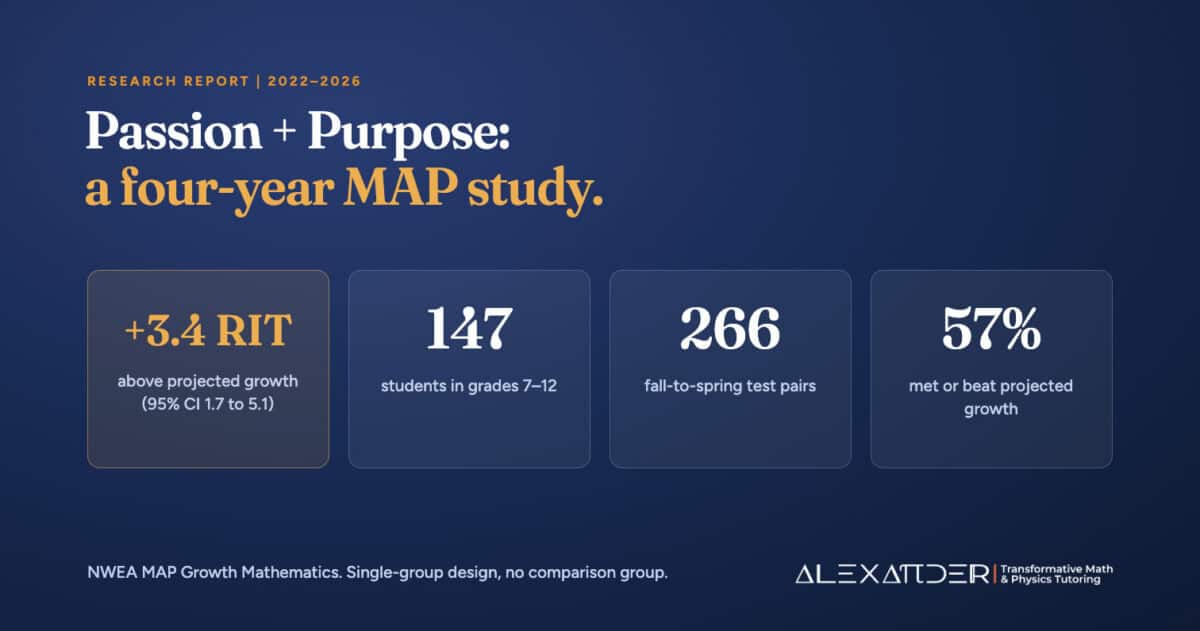
With test scores out of UC admissions and grades less trustworthy, families are more on their own to judge whether a student is actually ready for calculus, or for college. That is the gap independent, one-on-one tutoring is built to catch: an honest, outside read on a student’s real skill level, not their GPA or AI-assisted homework. If calculus is on the horizon, our guides to senior-year math and preparing for college math are a good place to start, and our four-year study of student growth shows what measured progress looks like.
Tutor-written guide · PDF
Tips for Performing Well During STEM Exams
The game plan our tutors give students before a big math or science test. Enter your name and email and the guide opens right away.
- The night-before routine that beats cramming
- A first-five-minutes plan: formula dump, read-through, quick wins
- Halfway and 10-minute checkpoints so time never runs out
- Calm-down steps for test anxiety you can use mid-exam
Frequently asked questions
Does the University of California use SAT or ACT scores?
No. The UC Regents voted in May 2020 to suspend the SAT and ACT requirement, and UC has not considered test scores in admissions decisions since fall 2021. In 2026, more than 1,400 UC faculty asked UC to require the tests again for STEM applicants.
Are college students less prepared for math than before?
At UC Berkeley, the share of incoming Calculus I students ready or nearly ready for calculus fell from 71% in 2018–2020 to 44% by 2023, and UC San Diego reports the number of entering students below high school math level grew nearly thirtyfold from 2020 to 2025.
Is AI to blame for falling math skills?
Not on its own. UC faculty point to test-blind admissions and grade inflation as well. AI adds to the problem by letting students turn in homework they can’t do on their own, and by making them feel they understand methods they can’t reproduce.
Should students use AI for math homework?
No. AI can show how a problem is solved and it can fake a homework assignment, but it can’t build the skill. Students learn math by working problems on their own, and students who lean on AI tend to fail the exams, where there is nothing to copy.
How can parents tell if their student is ready for college math?
Look past grades. Have your student solve problems from their current course without notes or AI, and check whether they can explain each step. A tutor can give an independent assessment of what’s mastered and what’s missing.
Can AI replace a math tutor?
No. AI can explain a solution, but it usually accepts a correct answer at face value. A human tutor asks students to explain their thinking, which exposes gaps AI misses. Harvard Graduate School of Education researchers called this warm accountability in their review of one-on-one sessions taught by Alexander Tutoring tutors.
An honest read on your student’s math
Our tutors are working mathematicians, scientists and engineers who teach one-on-one, online. Your first lesson is risk-free. Explore online math and science tutoring or meet our tutors.
Get in touch → We respond within 30 minutes.