Short answer: The area of a circle is A = πr², where r is the radius and π is about 3.14159. Square the radius, then multiply by π. If you know the diameter, halve it first to get the radius. A circle with radius 5 cm has area 25π, about 78.54 square centimeters.
That one formula covers almost every circle problem in middle school, high school and on the SAT and ACT. Below you will find worked examples, the most common mistakes, and a short derivation that shows exactly where πr² comes from.
Key points
- The formula: Area equals π times the radius squared: A = πr².
- Radius, not diameter: The radius is half the diameter, so divide the diameter by 2 before squaring.
- Square units: Area is always in square units, such as cm² or ft².
- Exact or decimal: Leave answers as a multiple of π for an exact value, or multiply by 3.14159 for a decimal.
- Double r, quadruple A: Because r is squared, doubling the radius makes the area four times larger.
- Built from triangles: Slicing a circle into thin triangles shows why the formula is ½ × circumference × radius.
What is the formula for the area of a circle?
A = πr²
- A is the area, the amount of flat space inside the circle.
- r is the radius, the distance from the center to any point on the circle.
- π (pi) is the ratio of any circle’s circumference to its diameter, about 3.14159.
Two related measurements show up in the same problems. The diameter is twice the radius, d = 2r. The circumference, the distance around the circle, is C = 2πr, which is the same as C = πd.
Which formula should you use?
Every circle area problem gives you one measurement. Use this table to go straight from what you know to the area.
| You are given | First step | Area formula |
|---|---|---|
| Radius r | None | A = πr² |
| Diameter d | r = d ÷ 2 | A = π(d ÷ 2)² = πd² ÷ 4 |
| Circumference C | r = C ÷ (2π) | A = C² ÷ (4π) |
| Area A, need radius | Work backward | r = √(A ÷ π) |
How do you find the area of a circle? Worked examples
Example 1: area from the radius
Find the area of a circle with a radius of 5 cm.
- Write the formula: A = πr².
- Square the radius: 5² = 25.
- Multiply by π: A = 25π cm².
- For a decimal, use π ≈ 3.14159: A ≈ 78.54 cm².
Example 2: area from the diameter
A round table has a diameter of 12 inches. What is its area?
- Halve the diameter to get the radius: r = 12 ÷ 2 = 6 in.
- Square the radius: 6² = 36.
- Multiply by π: A = 36π ≈ 113.10 in².
Tutor tip: The most common error on circle problems is plugging the diameter straight into πr². Using 12 instead of 6 here gives 144π, which is four times too big. Circle the word “diameter” whenever you see it, and halve it before anything else.
Example 3: area from the circumference
A circle has a circumference of 20π cm. Find its area.
- Use C = 2πr to find the radius: 2πr = 20π, so r = 10 cm.
- Square the radius: 10² = 100.
- Multiply by π: A = 100π ≈ 314.16 cm².
Example 4: area of a semicircle
Find the area of a semicircle with radius 4 m.
- Find the full circle’s area: π × 4² = 16π m².
- Take half: A = 16π ÷ 2 = 8π ≈ 25.13 m².
A quarter circle works the same way: divide the full area by 4.
Example 5: one large pizza or two small ones?
Is one 16-inch pizza more food than two 8-inch pizzas? Pizza sizes are diameters.
- One 16-inch pizza: r = 8, so A = 64π ≈ 201 in².
- One 8-inch pizza: r = 4, so A = 16π ≈ 50 in².
- Two 8-inch pizzas: 2 × 16π = 32π ≈ 101 in².
The single large pizza has twice as much area as the two small ones combined. Because the radius is squared, doubling the diameter quadruples the area.
Formulas make sense when you see where they come from
If geometry feels like a list of rules to memorize, a tutor can rebuild it from the ground up, one idea at a time, so the formulas stick.
Book a risk-free first lesson →
Or explore our geometry tutoring.
What mistakes do students make with the area of a circle?
- Using the diameter as the radius. Always halve the diameter first.
- Squaring π along with r. πr² means π × r × r, not (πr)².
- Mixing up area and circumference. Area is πr² (square units). Circumference is 2πr (plain units).
- Forgetting square units. An area of 25π is in cm² if the radius was in cm.
- Rounding π too early. Keep π exact until the last step, then round once.
Tutor tip: To keep area and circumference apart, check the units. Area squares a length, so its formula has r². Circumference is a length, so its formula has plain r.
For more traps like these, see the 5 most common geometry mistakes.
Why is the area of a circle πr²?
You do not have to take the formula on faith. As Sean Alexander, founder of Alexander Tutoring, puts it:
“At Alexander Tutoring, we derive every formula. Instead of memorizing a formula and plugging numbers in, students see where it comes from.”
Sean Alexander, founder of Alexander Tutoring
Step 1: start with what pi means
For every circle, the circumference divided by the diameter is the same number, π. So C = πd, and since d = 2r, the circumference is C = 2πr.
Step 2: fill the circle with triangles
Cut the circle into identical thin slices from the center, like a pizza, and treat each slice as an isosceles triangle. Each triangle’s area is ½ × base × height. Here is the circle split into 12 triangles:
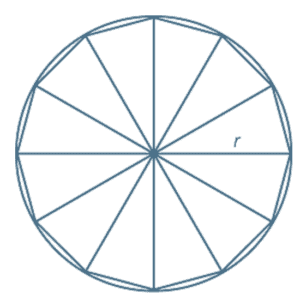
With n triangles, the total area is n × ½ × b × h, which we can regroup as ½ × (n × b) × h.
Step 3: use more and more triangles
Now make the triangles thinner and more numerous. Two things happen:
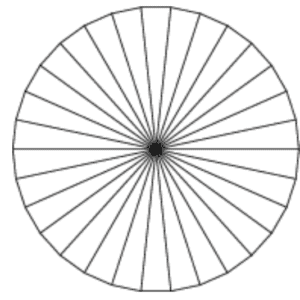
- The bases, laid end to end (n × b), hug the edge of the circle and approach the circumference, 2πr.
- The height of each triangle approaches the radius, r.
- Substitute both into ½ × (n × b) × h: A = ½ × 2πr × r.
- Simplify: the ½ and the 2 cancel, leaving A = πr².
“Packing in infinitely many triangles is actually a first step toward calculus.”
Sean Alexander, founder of Alexander Tutoring
Watch the full derivation step by step:
Sean Alexander, founder of Alexander Tutoring, builds the area of a circle formula from triangles and a limit, so there is nothing left to memorize.
“Once you go through this process, you’ll never forget πr² again.”
Sean Alexander, founder of Alexander Tutoring
This is also what the Common Core standards ask of 7th graders: know the area and circumference formulas and “give an informal derivation of the relationship” between them (Common Core 7.G.B.4). For the rest of that year’s content, see our 7th grade math guide.
How did mathematicians first work out pi?
Circles gave ancient mathematicians trouble because there are no straight edges to measure. Around 250 BC, Archimedes trapped the circle between regular polygons drawn inside and outside it. Using 96-sided polygons, he showed that π lies between 223/71 and 22/7, or roughly 3.1408 and 3.1429 (MacTutor History of Mathematics).
In 1761, Johann Lambert proved that π is irrational: its decimal never ends and never repeats. That is why answers are often left as a multiple of π, which is exact, rather than a rounded decimal.
How can you remember the area of a circle formula?
- Remember the derivation, not just the symbols. Half the circumference times the radius: ½ × 2πr × r = πr².
- Use units as a check. Area needs a squared length, so the formula with r² must be area.
- Practice with all three starting points. Radius, diameter and circumference problems each force a slightly different first step.
For more on making formulas stick, read how to memorize math formulas, and for test day, which math formulas to memorize for the SAT. To build stronger habits across geometry, see how to improve geometry problem-solving skills.
Tutor-written guide · PDF
Tips for Performing Well During STEM Exams
The game plan our tutors give students before a big math or science test. Enter your name and email and the guide opens right away.
- The night-before routine that beats cramming
- A first-five-minutes plan: formula dump, read-through, quick wins
- Halfway and 10-minute checkpoints so time never runs out
- Calm-down steps for test anxiety you can use mid-exam
Frequently asked questions
What is the formula for the area of a circle?
The area of a circle is A = πr², where r is the radius and π is about 3.14159. Square the radius and multiply by π.
How do you find the area of a circle with the diameter?
Divide the diameter by 2 to get the radius, then use A = πr². For a diameter of 12, the radius is 6 and the area is 36π, about 113.10 square units. You can also use A = πd² ÷ 4.
How do you find the area of a circle from the circumference?
Divide the circumference by 2π to get the radius, then use A = πr². A shortcut is A = C² ÷ (4π).
What is the area of a circle with a radius of 1?
A circle with radius 1 has an area of exactly π, about 3.14 square units, because 1² = 1.
Is area of a circle πr² or 2πr?
Area is πr², measured in square units. The formula 2πr gives the circumference, the distance around the circle, measured in plain units of length.
Why is the area of a circle πr²?
Slicing a circle into many thin triangles shows that its area equals half the circumference times the radius. Since the circumference is 2πr, the area is ½ × 2πr × r = πr².
Make geometry click
Our tutors are working mathematicians, scientists and engineers who teach one-on-one, online. Your first lesson is risk-free. Explore geometry tutoring or meet our tutors.
Get in touch → We respond within 30 minutes.