Short answer: Kumon buys daily worksheet practice, priced per subject by each center. Mathnasium (about $430 to $580 a month where posted) and Sylvan ($50+ per session) buy small-group help at a center. Marketplace tutors cost about $25 to $60 an hour, and specialist one-on-one tutors $150 an hour or more. The right tier depends on the problem.
Most families comparing Kumon and Mathnasium are really asking a price question: what do I get if I pay more? This guide sorts the options into four price tiers and judges each the same way. Alexander Tutoring is a specialist one-on-one service, so read this with that in mind; every outside price links to the page it came from.
Key points
- Worksheet programs: Kumon is daily, self-paced practice in math or reading, charged per subject per month.
- Learning centers: Mathnasium and Sylvan run assessment-based plans in small groups at a local center.
- Marketplace tutors: Sites like Wyzant and Care.com list independent tutors at about $25 to $60 an hour.
- Specialist one-on-one: Tutors hired for depth in one subject or test, from about $150 an hour.
- Same four questions: Who teaches, whether they can teach, what surrounds the session, and who stands behind the result.
- Cheaper can be right: For routine practice or occasional homework help, a lower tier is often the better buy.
What do you get at each price point?
Tutoring prices spread widely, and the spread follows four things. A separate guide to what a math tutor costs explains them in detail. Here is each tier through those four lenses, with prices checked October 8, 2026 and linked to sources below.
| Worksheet program (Kumon) | Learning center (Mathnasium, Sylvan) | Marketplace tutor (Wyzant, Care.com) | Specialist one-on-one | |
|---|---|---|---|---|
| Typical price | Monthly fee per subject; varies by center | Mathnasium about $430–$580/month where posted, plus enrollment fee; Sylvan $50+ per session | About $25–$60 per hour | About $150+ per hour, or a monthly plan |
| Who is teaching | Students work mostly on their own, with instructor support | Instructors trained in the center’s own method | Whoever lists a profile; backgrounds range widely | Tutors hired for depth in one subject or test |
| Whether they can teach | Learning comes from graded repetition, not explanation | Assessment, then a set plan worked through in a small group | Depends entirely on the individual tutor | Lessons built around one student’s course and gaps |
| What surrounds the session | Daily home worksheets, about two center visits a week | Shared instructor (about 3–4 students at Mathnasium; mostly small groups at Sylvan) | Usually just the booked hour | Full attention; some include help between sessions and progress reports |
| Who stands behind the result | Month-to-month fee; ask about withdrawal terms | Membership or per-session billing; ask about cancellation terms | You vet, hire and replace the tutor yourself | Varies widely; ask for refund or guarantee terms in writing |
What do you get from a worksheet program like Kumon?
Kumon is built on short, daily practice. Each child starts at a level where they can succeed and moves forward regardless of grade level, through similar exercises that gradually get harder, according to the Kumon FAQ.
- Subjects: math and reading, age three through high school.
- Daily work: assignments every day, designed to take under 30 minutes per subject.
- Center visits: most students attend class twice a week and do the rest at home.
What the money buys is routine and volume. What it does not buy is much explanation: the work is mostly independent, so a student who is confused by new material will need help from somewhere else.
What do you get from a learning center like Mathnasium or Sylvan?
Learning centers add a person in the room and a plan. Both chains start with an assessment and teach mostly in small groups, in a center or online.
Mathnasium is math-only, pre-K through high school. Its How It Works page describes a diagnostic assessment, a customized learning plan, and sessions with trained instructors. One center describes a group as one instructor with three or four students (Mathnasium of West Seattle); another describes a “pod” of up to three, with one-hour sessions through pre-algebra and 1.5 hours for algebra and up (Mathnasium of Delray Beach).
Sylvan covers more ground: math, reading, homework help, coding, advanced-course support and SAT and ACT prep, per Sylvan’s FAQ. Most tutoring is in small groups, with each student getting one-on-one attention during the session plus independent practice time. Sessions typically last an hour, and Sylvan’s tutors are trained and certified in its own instructional techniques.
What the money buys is structure, a place to go, and an adult checking the work. The trade-off is shared attention: the instructor is dividing the hour among several students working on different things.
How much does Mathnasium cost per month and per hour?
Mathnasium’s corporate site does not list prices; rates vary by location and families are asked to contact their center (Mathnasium blog). Some centers publish their membership prices:
| Mathnasium center | Monthly membership | Enrollment fee |
|---|---|---|
| Winnetka, IL | $449 (K–8, twice a week) to $579 (grades 9–12, unlimited) | $199 |
| Long Beach, CA | $429 (K–8, twice a week); $529 (grades 9–12) | $199 |
| Redwood City, CA | $559 (K–8 standard); $360 (pre-K to K) | $149 (waived online) |
Checked October 8, 2026. These are higher-cost areas; your local center may differ.
Per hour: a $449 twice-a-week membership covers about 8 or 9 sessions a month, which works out to roughly $50 to $56 per session (simple division, not a published rate). With one-hour sessions for younger students, that is close to $50 to $56 an hour.
How much does Kumon cost?
Kumon tuition varies by location, and centers charge a monthly fee per subject, so math and reading together means two fees. Kumon does not publish a national price and asks families to contact their local center (Kumon FAQ). No current figure from Kumon or reliable reporting could be verified for this guide, so the honest answer is: ask your local center.
How much does Sylvan Learning cost?
Sylvan centers are locally owned, so prices vary. Sylvan’s pricing page lists typical rates of $50+ per session for personalized tutoring and homework help and $900+ per class for ACT and SAT group classes.
Tutor tip: To compare Kumon, Mathnasium and Sylvan on cost, ask each center the same three questions: the monthly fee, any enrollment or materials fee, and how many sessions or subjects that fee covers. Then divide to get a price per session.
What do you get from a marketplace tutor?
Marketplaces and listing sites connect you with independent tutors who set their own rates. Wyzant says its tutors cost $35 to $60 an hour on average, and Care.com’s US math tutor rates average $24.85 to $33.94 an hour.
What the money buys is one-on-one time at a low hourly rate. Who you get ranges from a college student who recently passed the course to an experienced teacher, and the vetting is up to you. For homework help in a course the tutor knows well, that can be excellent value. A separate comparison of Wyzant vs. Varsity Tutors covers the two largest platforms.
What do you get from a specialist one-on-one tutor?
At the top of the range, you pay for depth in one subject and a lesson built entirely around one student. Princeton Review’s private PSAT tutoring, for example, runs $150 to $160 an hour in prepaid packages ($1,600 for 10 hours, $2,700 for 18 hours).
Some companies price by the month. Alexander Tutoring, for example, charges $895 a month for one-on-one tutoring with working mathematicians, physicists and engineers, including nightly office hours and monthly progress reports, plus a $295 a month office-hours-only plan, with no contract and a full-semester refund guarantee.
The case for this tier is strongest high in the curriculum. Plenty of people can teach pre-algebra well. Far fewer can teach AP Physics C or multivariable calculus, and teach it rather than simply know it.
Tutor tip: Whichever tier you choose, ask exactly who will be teaching your child and what their background is in the subject. For calculus or physics, that answer matters more than anything else on the brochure.
Do you get what you pay for in tutoring?
Mostly. The research points at what raises the price: who tutors, and how.
- Who tutors matters. A National Bureau of Economic Research review of randomized tutoring studies found larger gains from programs using teachers and trained paraprofessionals than from nonprofessional or parent tutors (Nickow, Oreopoulos and Quan, 2020).
- One-on-one is the strongest format. In Benjamin Bloom’s classic 1984 study, students taught one-on-one far outperformed students taught in a conventional class (Bloom, Educational Researcher).
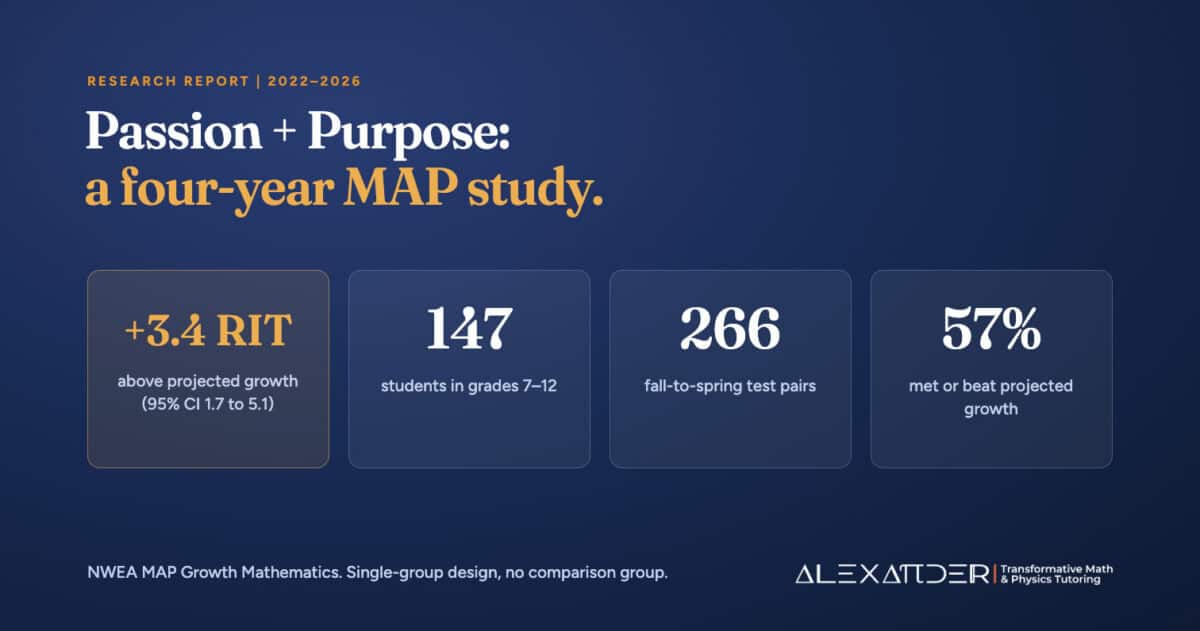
- Provider data is weaker evidence. Results published by tutoring companies, including Alexander Tutoring’s own four-year MAP Growth study, usually lack a control group, so read them as a signal rather than proof.
Is the course itself the problem?
If your student is falling behind in precalculus, calculus or physics, a one-on-one lesson with a working mathematician or physicist will show you exactly where things stand.
Book a risk-free first lesson →
Or explore our online tutoring services.
Kumon vs Mathnasium: which is better?
- Kumon relies on short daily worksheets, mostly done at home. It suits a child who needs speed and accuracy on fundamentals, and it also covers reading.
- Mathnasium does the work in the center, in small groups, following a plan built from an initial assessment. It suits a child who needs math help but would not keep up daily work alone.
Sylvan vs Mathnasium: which is better?
If math is the only concern, Mathnasium is the specialist and Sylvan the generalist. Sylvan makes more sense when a child also needs reading or homework support, or when you want SAT or ACT prep under the same roof.
What do reviews say?
Treat ratings as a snapshot: the samples are small, and a national page says little about the center near you. Checked October 8, 2026:
- Mathnasium: 4.1 out of 5 on Trustpilot from 95 reviews.
- Sylvan Learning: 3.2 out of 5 on Trustpilot from 8 reviews, too small a sample to conclude much.
- Kumon: 1.9 out of 5 on an unclaimed Trustpilot page from 15 reviews, also too small to draw conclusions.
Which tier fits your student?
Start with the problem, not the price. The cheaper tiers are the right choice for many families, and paying more for a problem that doesn’t need it is money wasted.
- Needs arithmetic fluency and a routine: a worksheet program like Kumon, if your family can keep a short daily habit going.
- Needs structure and a place to go: a learning center like Mathnasium (math only) or Sylvan (several subjects), if an in-person schedule suits you.
- Needs occasional homework help: a marketplace tutor who knows the course, at an hourly rate you control.
- The course itself is the problem, or the stakes are high: a specialist one-on-one tutor, for example when AP Calculus or physics is slipping, an honors placement is coming up, or the SAT matters for selective colleges. Alexander Tutoring offers math tutoring and physics tutoring at this tier.
Tutor tip: Before you call anyone, write one sentence naming the actual problem: not enough practice, trouble across several subjects, or real confusion about the material. That sentence usually points to the right tier.
A roundup of the best online tutoring services covers the main online options.
Tutor-written guide · PDF
Tips for Performing Well During STEM Exams
The game plan our tutors give students before a big math or science test. Enter your name and email and the guide opens right away.
- The night-before routine that beats cramming
- A first-five-minutes plan: formula dump, read-through, quick wins
- Halfway and 10-minute checkpoints so time never runs out
- Calm-down steps for test anxiety you can use mid-exam
Frequently asked questions
Is Kumon or Mathnasium better?
Kumon is better for a child who needs daily, independent practice for speed and accuracy, in math or reading. Mathnasium is better for a child who needs math help in the center, in small-group sessions guided by an instructor and a plan built from an assessment.
How much does Mathnasium cost per month?
Mathnasium does not publish a national price, and rates vary by center. Centers that list prices online, such as Winnetka, Illinois and Redwood City, California, charged about $430 to $580 a month in October 2026, plus a one-time enrollment fee of $149 to $199.
How much does Mathnasium cost per hour?
Mathnasium charges a monthly membership rather than an hourly rate. At a center charging $449 a month for two sessions a week, that is about $50 to $56 per session, and sessions for younger students typically last about an hour.
How much does Kumon cost?
Kumon tuition varies by location and is a monthly fee per subject, so math and reading together cost two fees. Kumon does not publish a national price, so ask your local center.
Is Sylvan or Mathnasium better for math?
Mathnasium is math-only and built around a math learning plan, which suits a student whose only need is math. Sylvan covers math alongside reading, homework help and test prep, from $50+ per session, which suits a student who needs help across several subjects.
Is a more expensive tutor worth it?
Only when the problem calls for it. Research links bigger gains to trained tutors and one-on-one formats, which cost more. For routine practice or occasional homework help, a worksheet program, learning center or marketplace tutor is often the better value.
Find the right fit for your student
Our tutors are working mathematicians, scientists and engineers who teach one-on-one, online. Your first lesson is risk-free. Explore online tutoring services or meet our tutors.
Get in touch → We respond within 30 minutes.