Short answer: A math tutor typically costs about $25 to $60 an hour through tutoring marketplaces and listing sites, $150 or more an hour for specialist test prep, and roughly $450 to $580 a month at a math learning center. Price tracks who is teaching, what surrounds the sessions, and whether anyone stands behind the result.
The range is wide because “math tutor” covers everything from a college student helping with pre-algebra to a working mathematician teaching AP Calculus BC. Below: sourced 2026 rates, what drives them, and how to find the right tutor.
Key points
- Marketplace rates Wyzant says its tutors cost $35 to $60 an hour on average.
- Listing-site averages Care.com’s US math tutor rates average $24.85 to $33.94 an hour.
- Learning centers Sampled Mathnasium centers charge $449 to $579 a month, plus enrollment fees.
- Test-prep specialists Princeton Review’s private PSAT tutoring runs $150 to $160 an hour.
- Price follows the tutor Training, teaching skill, support between sessions and guarantees drive the spread.
- Trial before you commit Whether your child clicks with a tutor cannot be judged from a bio.
How much does a math tutor cost per hour?
Here is what published 2026 prices look like by type of tutoring. Each figure comes from the provider’s own page, checked in October 2026; local prices vary.
| Type of tutoring | Published price | How it’s priced | Source |
|---|---|---|---|
| Independent tutors on listing sites | $24.85 to $33.94 per hour (US average starting and max rates) | Hourly, set by each tutor | Care.com math tutor rates |
| Online tutoring marketplace | $35 to $60 per hour on average, with listings from $20 | Hourly, set by each tutor | Wyzant |
| Math learning center | $449 to $579 per month, plus a $149 to $199 enrollment fee | Monthly membership, often two one-hour sessions a week | Mathnasium Glenview and Redwood City |
| Specialist test-prep tutoring | $150 to $160 per hour ($1,600 for 10 hours, $2,700 for 18 hours) | Prepaid hour packages | Princeton Review PSAT tutoring |
| Alexander Tutoring | $895 per month one-on-one; $295 per month office hours only | Monthly, no contract | See below |
Learning center prices are set center by center; the Redwood City center’s $559 a month covers two one-hour sessions a week. For how the two biggest center chains compare in format, see Kumon vs Mathnasium vs Sylvan: what you get for the price.
What the tutor earns is only part of what you pay. The U.S. Bureau of Labor Statistics puts the median pay for tutors at $20.84 an hour (May 2025), so most of the spread in prices reflects who the tutor is and what the company wraps around the session.
What does a math tutor cost per month?
Most families think in monthly budgets, so convert hourly rates the simple way: hourly rate × sessions per week × about 4.3 weeks.
| Example | Calculation | Approximate monthly cost |
|---|---|---|
| One hour a week at $35 | $35 × 1 × 4.3 | About $150 |
| Two hours a week at $60 | $60 × 2 × 4.3 | About $516 |
| One hour a week at $150 | $150 × 1 × 4.3 | About $645 |
These are illustrations, not quotes. Ask every provider for the full monthly figure, including enrollment fees, cancellation rules and what happens to unused hours.
Why do tutoring rates per hour vary so much?
Tutoring rates vary more than almost any other professional service, and in San Francisco, New York and similar markets the whole range shifts upward. The spread is not arbitrary. It maps to four things:
| What drives price | Lower end | Higher end |
|---|---|---|
| Who is teaching | An undergraduate who recently passed the course | Someone with a graduate degree and professional research experience in the field |
| Whether they can teach | Subject mastery only | Subject mastery plus teaching ability, which is rarer |
| What surrounds the session | An hour a week with no support between sessions | Ongoing access, coordination with the school, and a plan that adapts |
| Who stands behind the result | Sold by the hour, no accountability for outcomes | A guarantee tied to the result |
For precalculus, calculus and physics the bar rises sharply. Many college students tutor, and some are excellent, but there is a wide gap between having passed a course and being able to teach it. The lower rate is real. So is the reason for it.
Online tutoring widens the pool: few people can teach AP Physics C, and a twenty-mile radius makes that pool much smaller. Our roundup of the best online tutoring services compares the main options.
Is an expensive math tutor worth it?
That depends entirely on the situation. For occasional pre-algebra homework support, a capable college student at an hourly rate is a reasonable choice, and we’d be an expensive way to solve it.
If your child is in AP Calculus and the grade is slipping, or preparing for the SAT with selective colleges in view, the calculation changes. At that level the difference between a competent tutor and an exceptional one shows up in the transcript, and transcripts are permanent.
Every Ivy League school, along with Stanford and Georgetown, has now reinstated SAT and ACT requirements, which raises the stakes on exactly the coursework that’s hardest to teach. The honest framing: you generally get what you pay for, and the worst outcome is paying for tutoring and still getting the F.
Tutor tip: Match the tutor to the stakes. Occasional homework help and a slipping AP Calculus grade are different problems that justify different budgets.
What does Alexander Tutoring charge, and why?
Alexander Tutoring is $895 per month for one-on-one mentoring. We also offer an office-hours-only plan at $295 per month for students who need homework support rather than a dedicated tutor. We are not the cheapest option and we don’t try to be.
Here is what that buys, and you should weigh it against the alternatives honestly:
- Your tutor is a working mathematician, physicist or engineer. People who use this material professionally, with graduate-level training and research experience. We recruit nationally because that is the only way to find them, which is also why we work online. You can meet our tutors before you decide.
- We teach derivation, not procedure. Every equation gets derived rather than memorized. This is slower at first and it is the entire difference between a student who can do the homework and a student who can handle a problem they haven’t seen.
- The match is the product. We pair on personality and interest before subject: a physicist who races bikes, a mathematician who plays in a band. If the fit isn’t right, you get another match at no cost, as many times as it takes. About 80% of students click on the first try and 95% by the second.
- Support between sessions. Nightly office hours mean homework trouble on a Tuesday doesn’t wait until Thursday.
- We stand behind it. The first lesson is risk-free with no credit card required. And our Full Semester Guarantee is exactly what it sounds like: if you’re not satisfied at the end of the term, we refund every penny. There’s no contract and you can cancel anytime.
“At Alexander Tutoring, we derive every formula. Instead of memorizing a formula and plugging numbers in, students see where it comes from.”
Sean Alexander, founder of Alexander Tutoring
Do you get what you pay for in tutoring?
Mostly, yes. Research on tutoring is unusually consistent that who tutors, and in what format, drives the result. Those are the same things that make tutoring cost more.
- Expertise moves results. A National Bureau of Economic Research review of randomized tutoring studies found an average gain of 0.37 standard deviations, and larger effects from programs using teachers and trained paraprofessionals than from nonprofessional or parent tutors (Nickow, Oreopoulos and Quan, 2020).
- One-on-one is the strongest format. In Benjamin Bloom’s classic 1984 study, the average student taught one-on-one scored above 98% of students taught in a conventional class (Bloom, Educational Researcher). Later trials, like those in the NBER review, find smaller average effects, but still large by education standards.
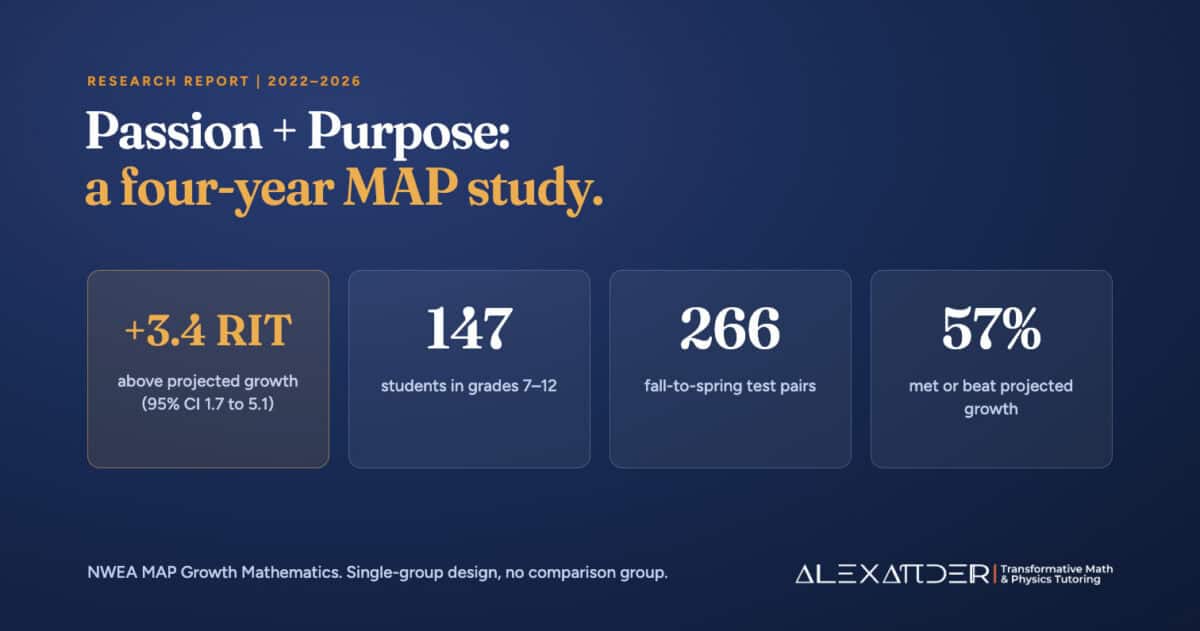
- Our own numbers. In our four-year MAP Growth study of 147 students in grades 7 to 12 receiving one-on-one tutoring, students gained 6.7 RIT points from fall to spring on average, about twice the 3.3 points national norms projected. The study had no control group, so read it as a strong signal rather than proof.
That changes how to compare prices. The hourly rate is the wrong unit; the right one is what a semester costs against what actually changes. At $40 an hour, one session a week for a semester costs roughly $700, and if the grade doesn’t move, you have spent the money and the semester. A higher rate that comes with real expertise, one-on-one attention and a guarantee is often the cheaper choice per result.
Tutor tip: Ask any tutor, at any price, how you will know it is working and what happens if it isn’t. A tutor who expects results will have a specific answer. Price alone is not proof of quality, so still check credentials and insist on a trial, as covered below.
Compare us on what you actually get, not just the rate
Tell us the course and what’s going wrong, and we’ll match your child with a working mathematician, physicist or engineer who has taught it. If the fit isn’t right, we rematch.
Book a risk-free first lesson →
Or explore our online math tutoring.
Does my child need a math tutor?
Before you spend anything, be sure tutoring is the right fix. Three signals are worth paying attention to.
Are their grades slipping?
If your child used to get A’s in math and is now getting B’s and C’s, something changed, and it’s rarely effort.
You may be tempted to help with homework yourself. Be careful. Parent-led tutoring sessions frequently end in frustration on both sides, and they can attach a negative feeling to the subject itself. Being good at math also doesn’t make someone good at teaching it.
Has their confidence changed?
Watch for the shift from “I got this wrong” to “I’m bad at math.” That’s a story a student starts telling themselves, and it usually traces back to one specific moment:
- Being called to the board without the answer.
- A placement in the wrong group.
- An illness that interrupted a unit at the wrong time.
Once that story takes hold, a student stops trying. Confidence and mathematical performance are tightly linked, and the confidence usually has to be repaired before the math can be.
“Students are afraid they’re behind, and they don’t want to be embarrassed. But this should never be about ego. It’s simply: where are you, what do we need to learn, and why does it matter?”
Jake Gerhardt, Alexander Tutoring math tutor
Is their schedule crowding out math?
A student with four extracurriculars and three hours of homework will triage, and math is often what gets triaged. Guessing on problem sets to save time produces grades that look like a comprehension problem but are actually a time problem, and those need different solutions.
How do you find a math tutor for your child?
The process at a glance, with each step explained below:
- Start with what they actually need. Course, topics, and whether the issue is comprehension, confidence, organization or pace.
- Talk to your child first. Tutoring works better when the student has agreed to it.
- Ask people who have hired someone. Other parents and your child’s teacher.
- Search, then verify. Read reviews for substance and ask about credentials.
- Insist on a trial. Watch your child’s reaction after the first session.
What does your child actually need?
Tutors are not interchangeable. Someone excellent with a struggling sixth grader may be useless in AP Calculus BC. A tutor who says they can handle everything from third grade through multivariable calculus is telling you something.
If your child resists tutoring, that’s information rather than a verdict: the subject has become unpleasant, so look for someone experienced with reluctant students.
Who should you ask for recommendations?
Word of mouth is the most reliable filter, because it reports on outcomes rather than marketing. Ask other parents and your child’s teacher, who sees which students improve and often knows why.
How do you search for and verify a tutor?
Search by the specific course, such as calculus or trigonometry, rather than just “math,” so the results match the help your child needs.
Whoever you find, verify them. Reviews that describe a specific situation are worth more than a hundred that say “great tutor.” Ask directly about degrees, research or professional background, teaching experience, and experience with your child’s specific course.
What should you ask a prospective tutor?
Whether you go through a tutoring company or an independent tutor, a short conversation tells you a lot about personality, teaching style and method. Common questions include:
- How long have you been a tutor, and what are your specialties?
- What is your tutoring style and methodology?
- How do you measure student progress?
- What is your availability?
- What is the total monthly cost, and what is your cancellation policy?
State your child’s needs and goals from the outset, and ask for examples of similar students they have taught. If the goal is a standardized test, also ask about their knowledge of the test and any recent changes to its format.
Why insist on a trial?
Whether student and tutor click matters more than the hourly rate, and it cannot be assessed from a bio. If you ask how it went and get “fine,” keep looking. Start early in the semester: discovering the wrong fit in week ten is an expensive way to learn.
Tutor tip: After the first session, don’t ask “How did it go?” Ask what the tutor explained. A child who can retell the idea in their own words, unprompted, has found a good fit.
How do you know you’ve found the right math tutor?
You’ll know from your child’s face. The goal isn’t a better grade, though that follows. It’s a student who stops dreading the subject, and tutoring works far better as prevention than as rescue.
We work with students across the Bay Area and nationally, from elementary arithmetic through university coursework. Learn more about our math tutoring, or see our work in San Francisco and New York.
Tutor-written guide · PDF
Tips for Performing Well During STEM Exams
The game plan our tutors give students before a big math or science test. Enter your name and email and the guide opens right away.
- The night-before routine that beats cramming
- A first-five-minutes plan: formula dump, read-through, quick wins
- Halfway and 10-minute checkpoints so time never runs out
- Calm-down steps for test anxiety you can use mid-exam
Frequently asked questions
How much does a math tutor cost?
Published 2026 rates put most math tutors at about $25 to $60 an hour through listing sites and marketplaces such as Care.com and Wyzant. Specialist test-prep tutoring runs $150 or more an hour, and math learning centers commonly charge about $450 to $580 a month.
How much does a math tutor cost per hour?
Care.com’s October 2026 data shows US math tutor rates averaging $24.85 to $33.94 an hour, and Wyzant says its tutors average $35 to $60 an hour. Tutors with graduate degrees, test-prep specialists, and tutors in markets like San Francisco and New York charge more.
Is a learning center cheaper than a private tutor?
Not always. Sampled Mathnasium centers charge $449 to $579 a month plus an enrollment fee, which is comparable to two hours a week with a $55 to $65 an hour private tutor. Compare what each session includes, not just the price.
How do I know if my child needs a math tutor?
Watch for three signals: grades that have dropped, confidence that has shifted to “I’m bad at math,” and a schedule so full that math homework is being rushed or guessed. Each points to a different fix, so it helps to know which one you’re seeing.
Why is a trial lesson important when choosing a tutor?
Whether the student and tutor click is the single most important variable, and it cannot be judged from a bio. After a good first session a child comes out animated and talks about it without being asked.
Find a math tutor your child actually clicks with
Our tutors are working mathematicians, scientists and engineers who teach one-on-one, online. Your first lesson is risk-free. Explore online math tutoring or meet our tutors.
Get in touch → We respond within 30 minutes.