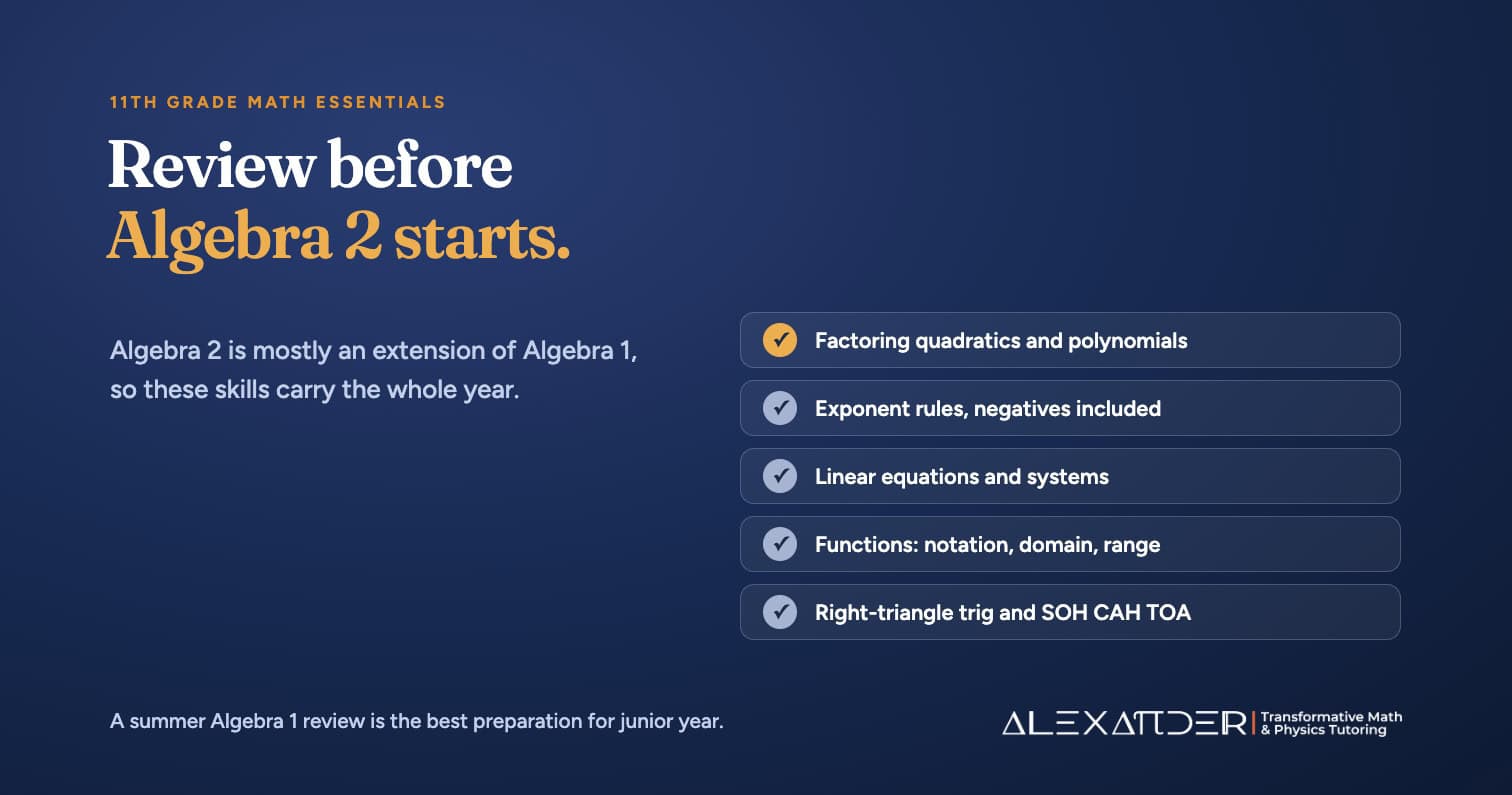
Short answer: Most 11th graders take Algebra 2 (or Integrated Math III). The course extends Algebra 1 into polynomial, rational and radical functions, exponential and logarithmic functions, complex numbers, unit-circle trigonometry and statistics. Before it starts, students should review factoring, exponent rules, linear equations, function basics and right-triangle trigonometry.
Junior year is when math gets more abstract, and it is also the year of the PSAT/NMSQT and, for many students, the SAT or ACT. Gaps from Algebra 1 and Geometry show up fast, so the summer before is the best time to fix them.
Key points
- Usually Algebra 2: Most juniors take Algebra 2; accelerated students often take precalculus instead.
- An extension of Algebra 1: Most of Algebra 2 builds directly on Algebra 1, so old gaps resurface.
- Four big areas: Polynomials and rational functions, trigonometric functions, modeling with functions, and statistics.
- New ideas arrive: Logarithms, complex numbers and the unit circle are new to most students.
- Review in summer: A summer Algebra 1 review is the most useful preparation for Algebra 2.
- Watch for red flags: Freezing on unfamiliar problems or skipping a problem type signals a foundational gap.
What math do 11th graders take?
It depends on the pathway. Common Core’s model pathways describe a traditional sequence (Algebra I, Geometry, Algebra II) and an integrated one (Mathematics I, II, III) (Common Core Appendix A: model course pathways).
| Pathway | 9th grade | 10th grade | 11th grade | 12th grade (typical) |
|---|---|---|---|---|
| Traditional | Algebra 1 | Geometry | Algebra 2 | Precalculus or statistics |
| Traditional, accelerated | Geometry | Algebra 2 | Precalculus | Calculus |
| Integrated | Math I | Math II | Math III | Precalculus or statistics |
Some schools add a separate trigonometry or statistics course. If your student is already in precalculus this year, see our 12th grade math guide, which covers that course in detail.
What topics are covered in Algebra 2?
The Common Core model Algebra II course is built around four critical areas. The function standards that drive most of the course are in the High School Functions domain.
- 4 critical areas in the model Algebra II course
- 3 new number and function ideas: logs, complex numbers, the unit circle
- 2 model pathways: traditional and integrated
| Critical area | What students learn | Quick check |
|---|---|---|
| Polynomial, rational and radical relationships | Factor higher-degree polynomials, connect zeros and factors, simplify rational expressions, solve with complex numbers | Factor x³ + 3x² + 2x + 6 |
| Trigonometric functions | Extend sine and cosine to all angles with the unit circle, use radians, model periodic behavior | What is sin 30°? |
| Modeling with functions | Transform, combine and invert functions; build exponential and logarithmic models | Solve 3ˣ = 81 |
| Inferences and conclusions from data | Normal distributions, surveys vs. experiments, margin of error, the role of randomness | Survey or experiment? |
What should students review before Algebra 2?
Our tutors’ curriculum notes put it simply: Algebra 2 is mostly an extension of Algebra 1, so an Algebra 1 review the summer before “can make all the difference.” Here is where each earlier skill shows up again.
| Earlier skill | Where it shows up in Algebra 2 |
|---|---|
| Factoring quadratics | Factoring polynomials, finding zeros, simplifying rational expressions |
| Exponent rules, including negative exponents | Exponential functions and logarithms |
| Function notation, domain and range | Transformations, composition and inverse functions |
| Quadratic formula and discriminant | Complex solutions when the discriminant is negative |
| Linear equations and systems | Larger systems and modeling problems |
| Right-triangle trigonometry (Geometry) | The unit circle and trigonometric functions |
Tutor tip: Do not try to preview all of Algebra 2 over the summer. Rebuild the Algebra 1 skills in this table until they are automatic; the new material goes much faster when the old steps take no effort.
What are the most important 11th grade math skills, with examples?
1. Factoring higher-degree polynomials
Factor x³ + 3x² + 2x + 6 by grouping.
- Group the terms: (x³ + 3x²) + (2x + 6).
- Factor each group: x²(x + 3) + 2(x + 3).
- Factor out the common binomial: (x² + 2)(x + 3).
Setting each factor to zero gives x = −3 as the only real zero, because x² + 2 = 0 has no real solutions.
2. Exponent rules
Simplify (2x³)² · x⁻⁴. Square each factor: 4x⁶. Then multiply by x⁻⁴ by adding exponents: 4x⁶⁺⁽⁻⁴⁾ = 4x². These same rules are what make logarithms work.
3. Composition and inverse functions
Let f(x) = 2x + 1 and g(x) = x².
- f(g(3)): first g(3) = 9, then f(9) = 19.
- g(f(3)): first f(3) = 7, then g(7) = 49. Order matters.
- Inverse of h(x) = 3x − 6: swap x and y and solve, giving h⁻¹(x) = (x + 6) ÷ 3. Check: h(2) = 0 and h⁻¹(0) = 2.
Get ahead of Algebra 2 before it gets ahead of you
One-on-one review of factoring, exponents and functions can turn junior year from stressful to manageable, and it sets up the SAT and precalculus too.
Book a risk-free first lesson →
Or explore our pre-calculus tutoring.
4. Logarithms
A logarithm answers the question “what exponent?” Since 2⁵ = 32, log₂ 32 = 5.
To solve 3ˣ = 81, write 81 as a power of 3: 81 = 3⁴, so x = 4. When the numbers are not neat, take a logarithm of both sides. Our guide to the natural logarithm and its rules goes further.
5. Complex numbers
Solve x² + 9 = 0. Then x² = −9, and since i² = −1, x = ±3i.
Multiplying conjugates removes i: (2 + 3i)(2 − 3i) = 4 − 9i² = 4 + 9 = 13. Complex solutions appear exactly when the discriminant of a quadratic is negative; see our quadratic formula guide.
6. The unit circle
The unit circle has radius 1 and is centered at the origin. A point on it at angle θ has coordinates (cos θ, sin θ), which is how sine and cosine extend beyond right triangles.
- Special right triangles give the key values: sin 30° = 1/2 and cos 60° = 1/2.
- Radians measure angles by arc length: 180° = π, so 45° = π/4 and 30° = π/6.
- The signs of x and y in each quadrant tell you the signs of cosine and sine.
Tutor tip: On any unit circle problem, sketch the angle and draw the right triangle down to the x-axis first. Most errors come from skipping the picture and guessing a sign.
What are the most common 11th grade math mistakes?
- Treating a log like a multiplier. log(a + b) is not log a + log b; the product rule is log(ab) = log a + log b.
- Losing negative exponents. x⁻² is 1/x², not −x².
- Composing in the wrong order. f(g(x)) means apply g first.
- Calling i² positive. i² = −1, which turns −9i² into +9.
- Degree mode vs. radian mode. Check the calculator mode before every trig problem.
- Following the example, not the idea. Students who memorize steps freeze when a problem is worded differently.
Many of these start as Algebra 1 habits; see the 5 most common algebra mistakes. AI homework helpers can make the last one worse:
“AI chatbots are inconsistent, because they depend on where they pull their information from. Students come away thinking they understand how to solve a problem when they really don’t.”
Jake Gerhardt, Alexander Tutoring math tutor
What are the red flags of a foundational gap?
- Homework or tests suddenly take much longer than before.
- Following a worked example but freezing on a problem with a slightly different structure.
- Consistently skipping one type of problem.
- Reciting the steps of a process without being able to apply them.
- Staying quiet in class to avoid showing confusion.
None of these mean a student is “bad at math.” They usually mean an earlier skill, such as exponents before logarithms, needs review.
How does 11th grade math set up senior year and beyond?
- Precalculus: deepens functions, trig identities and limits, building straight on Algebra 2.
- Testing: juniors take the PSAT/NMSQT in the fall, and functions, exponentials and quadratics are central to SAT and ACT math. See PSAT vs. SAT and which formulas to memorize for the SAT.
- STEM in college: in an ACT study of STEM success, 35% of students whose highest high school math was calculus earned a STEM bachelor’s degree within six years, compared with 29% of those whose highest course was Algebra II (ACT Research Report).
To see how the sequence fits together, read our 9th grade and 10th grade math guides.
How can parents help an 11th grader in Algebra 2?
- Plan a summer Algebra 1 review, spread over several weeks rather than crammed into the last few days.
- Ask your student to explain one problem out loud each week; it shows whether they understand the idea or only the steps.
- Look at quiz corrections, not just grades, for repeated exponent or sign errors.
- Map out the junior-year testing calendar early so test prep does not collide with Algebra 2 units.
Tutor tip: Juniors who are behind often hide it. Our tutors keep ego out of it: find where the student is, decide what to learn next, and explain why it matters.
Tutor-written guide · PDF
Tips for Performing Well During STEM Exams
The game plan our tutors give students before a big math or science test. Enter your name and email and the guide opens right away.
- The night-before routine that beats cramming
- A first-five-minutes plan: formula dump, read-through, quick wins
- Halfway and 10-minute checkpoints so time never runs out
- Calm-down steps for test anxiety you can use mid-exam
Frequently asked questions
What math do most 11th graders take?
Most US 11th graders take Algebra 2, or Integrated Math III at schools using an integrated pathway. Students who took Algebra 2 in 10th grade usually take precalculus in 11th grade.
Is Algebra 2 harder than Algebra 1?
Algebra 2 is more abstract, adding logarithms, complex numbers and the unit circle. But most of it extends Algebra 1, so students with solid factoring, exponent and function skills usually adjust well.
What should I review before Algebra 2?
Review factoring, exponent rules (including negative exponents), solving linear equations and systems, function notation with domain and range, the quadratic formula, and right-triangle trigonometry from Geometry.
Is trigonometry part of Algebra 2?
In the Common Core model course, yes: Algebra II includes trigonometric functions using the unit circle. Some schools teach trigonometry as a separate course or within precalculus instead.
Do 11th graders learn logarithms?
Yes. Logarithms are introduced in Algebra 2 as the inverse of exponential functions, and students use them to solve exponential equations such as 3ˣ = 81.
Can you skip Algebra 2?
Rarely. Algebra 2 is required for precalculus and calculus, is commonly expected by colleges, and its topics appear on the SAT and ACT. Ask your school counselor about local graduation and placement rules.
Make junior year math your strongest yet
Our tutors are working mathematicians, scientists and engineers who teach one-on-one, online. Your first lesson is risk-free. Explore pre-calculus tutoring or meet our tutors.
Get in touch → We respond within 30 minutes.
Author

Want Jake as your tutor?
Jake’s schedule is full. Join the waitlist and we’ll reach out the moment a spot opens. Meet Jake