Short answer: Why is math important? Because for your child, it’s one of the strongest advantages they can build for their future career. But most kids who dread math can’t see that, so it feels like a chore. When math connects to something they already love, like music, sports, art or games, it stops being homework and becomes a tool.
If you’ve ever heard “When am I ever going to use this?” at the kitchen table, you already know the real problem. It usually isn’t ability. It’s relevance. A child who sees no point in math will put in the minimum, and the minimum turns into a C, then into skipping the hard classes, then into closing doors they don’t even know exist yet.
Where Alexander Tutoring began: the roller coaster answer
I still remember the moment. I was sitting in my high school pre-calc class when a classmate asked the question every math teacher dreads: “When am I ever going to use this in my life?”
Our teacher thought for a second and said, “Well, what if you wanted to build a roller coaster one day?”
The whole class rolled their eyes at once. Kids are smart. Nobody in that room was going to build a roller coaster, and we all knew it. We could tell he was pulling one over on us, so we stopped taking the math seriously. Then we stopped taking him seriously.
In many ways, Alexander Tutoring was born in that moment. I decided that when I taught math, I would tell students the truth.
“Unless you go into math, engineering or the sciences, you probably won’t use math beyond a 4th grade level in everyday life. But math already lives inside the things you’re passionate about. Use it to understand your passion more deeply, and it becomes a real competitive advantage in the thing you love.”
Sean Alexander, founder
Students can hear the difference. An honest answer earns their trust, and a passion they already care about gives them a reason to lean in instead of tuning out.
That idea became our method, called Passion + Purpose. It starts with a simple belief: no student is bad at math. Most have just had bad math experiences.
Key points
- It’s a relevance problem: Kids treat math as a chore when nobody shows them what it’s for.
- Math is a career multiplier: STEM jobs are projected to grow about three times faster than other jobs, at roughly twice the median pay.
- Relevance raises grades: Randomized studies show that connecting class material to students’ lives improves interest and performance.
- Passion is the bridge: Every interest, from basketball to baking, has real math inside it.
- Parents matter: Teens whose parents talked about the value of math took more math and scored higher on the ACT.
- Tutors make it personal: A great tutor builds each lesson around what your child already cares about.
Why does my child see math as a chore?
Because, for most kids, school math is all “how” and no “why.” Students learn to factor a quadratic or find a derivative, but rarely see what either one is for. Nobody stops to answer the question every kid is really asking: why is math important to me? Without a reason, math becomes a series of hoops: memorize, repeat, forget.
That gap has real consequences. A student who feels math is pointless stops asking questions, avoids challenge problems and often develops math anxiety that follows them for years. Over time, the problem shifts from “I don’t care about math” to “I’m not a math person,” which is far harder to undo. We see this so often that we’ve written about how confidence and math performance feed each other.
The good news is that relevance is one of the most fixable problems in education.
Why is math important for my child’s future career?
Math is the quiet gatekeeper behind a huge share of the careers parents hope for. The numbers from the U.S. Bureau of Labor Statistics are striking:
STEM jobs are projected to grow 8.1% from 2024 to 2034, three times the 2.7% growth projected for all other jobs. The median STEM wage in 2024 was $103,580, more than double the $48,000 median for non-STEM jobs.
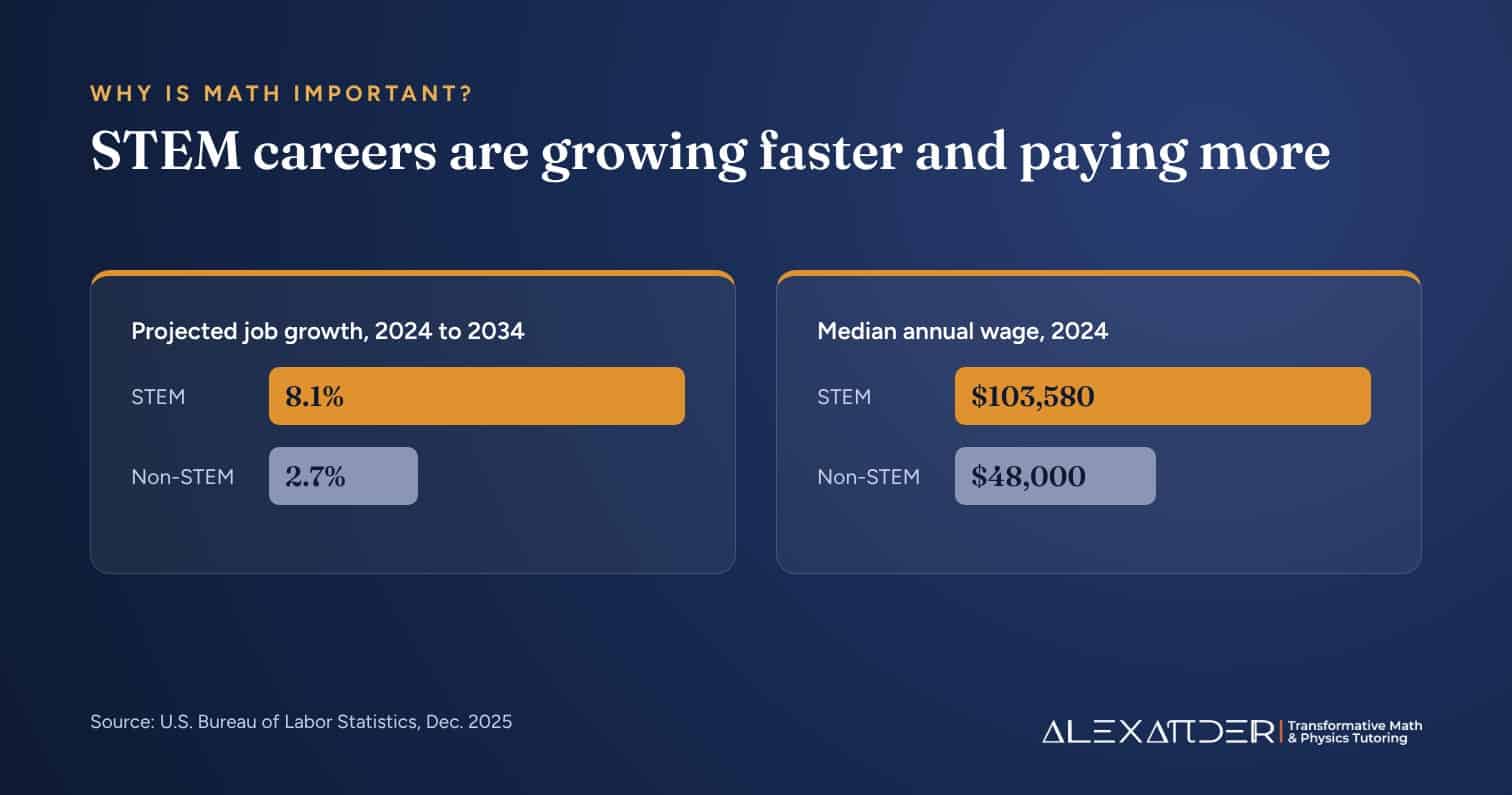
Source: U.S. Bureau of Labor Statistics, The Economics Daily (Dec. 2025). BLS also projects that math occupations overall will grow much faster than average, with data scientists among the fastest growing jobs of the decade.
But the advantage goes well beyond jobs with “math” in the title. Today, the student who is comfortable with numbers has an edge in nearly every field they might love:
| If your child loves… | The career math unlocks | Where math is the edge |
|---|---|---|
| Sports | Front office, scouting, sports analytics | Teams now hire statisticians to find undervalued players and better strategies |
| Music | Audio engineering, music production, acoustics | Sound is frequency, decibels are logarithms, and mixing is signal math |
| Video games | Game development, animation, software | Game engines run on vectors, physics and probability |
| Art and design | Architecture, animation, product design | Perspective, proportion and structure are all geometry |
| Helping people | Medicine, nursing, pharmacy, public health | Dosing, half-lives and medical research all depend on math |
| Money and business | Finance, entrepreneurship, investing | Compound growth, margins and risk are math |
| Politics and current events | Policy, law, campaigns, journalism | Polling, data and even fair district maps rely on statistics |
Math also decides which doors stay open in high school. Students who fall behind early often never reach calculus or physics, the classes that selective colleges and engineering, pre-med and business programs look for. A student who sees math as a chore at 13 can be locked out of a dream major at 18 without ever having made that choice. That, more than any test score, is why math is important to get right early.
Turn math into your child’s advantage
Tell us what your child loves. We’ll match them with a tutor who builds lessons around it, starting with a risk-free first lesson.
Does making math relevant actually improve grades?
Yes, and this is one of the better-studied ideas in education research. Psychologists call it utility value: how useful a student believes a subject is for their own life and goals.
- In a randomized field experiment with 9th graders, students who wrote about how their science lessons applied to their own lives became more interested, and students with low expectations raised their grades by about two thirds of a letter grade (Harackiewicz et al., Harnessing Values to Promote Motivation in Education).
- In a randomized trial with families, parents received short brochures about why math and science matter. Their teens took about 0.8 more semesters of math and science in 11th and 12th grade and scored about 12 percentile points higher on the ACT math and science sections (Rozek et al., PNAS, 2017).
- In our own four-year study of 147 students taught with the Passion + Purpose method, students averaged 6.7 points of growth on the NWEA MAP math test, about double the 3.3 points they were projected to gain.
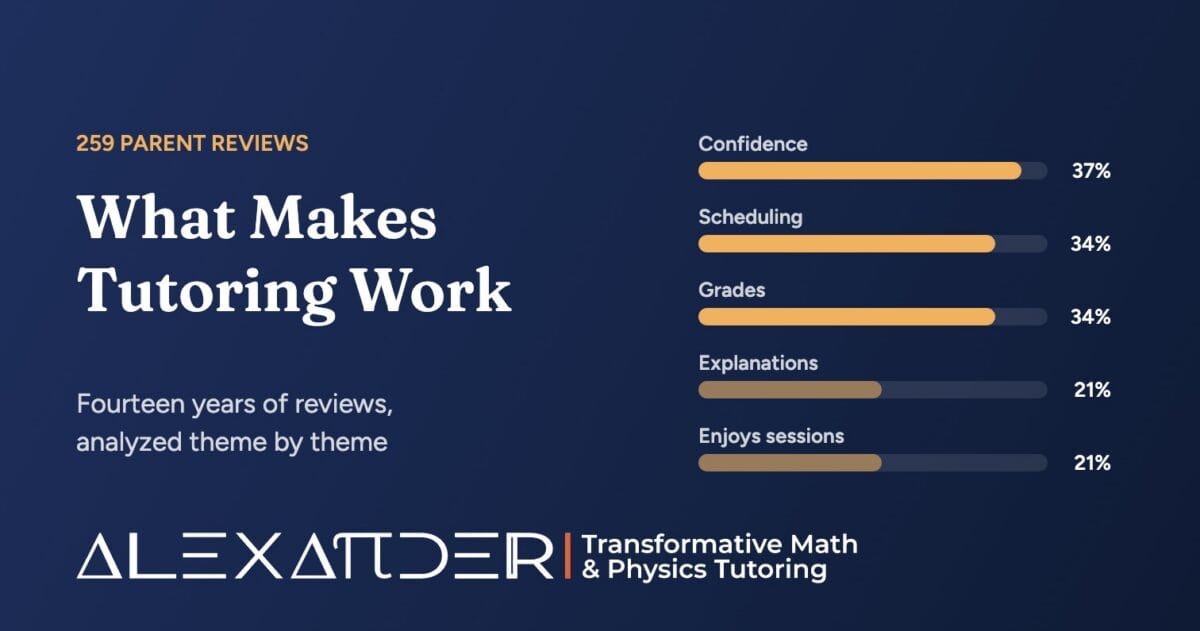
Parents notice the change too. When we analyzed 259 parent reviews, 57% described an emotional shift, like more confidence or a child who now looks forward to math, not just better grades.
How do we make math relevant to your child?
Every Alexander Tutoring tutor learns the same four-step approach. It takes about five minutes of a lesson, and it changes how the other fifty-five feel.
- Discover. In the first lesson, the tutor asks what your child does when nobody is making them do anything, and listens for specifics. “Basketball” is a start. “I play point guard and my three-point shot is streaky” is gold.
- Bridge. The tutor names the math hiding in that passion: “Your shot is a parabola, and we can find the angle that gives you the most room for error.”
- Solve. Together they work a real problem with real numbers from your child’s world, often data your child supplies.
- Return. The tutor ties it back to class: “That’s exactly the quadratic skill on Thursday’s test.” The passion opens the door, and the curriculum stays the destination.
This is one of the 50 tutoring moves we train for, and it only works when a tutor really knows the student. That’s why we match every family with one consistent tutor from our team of math and physics specialists.
What does real-life math look like for kids?
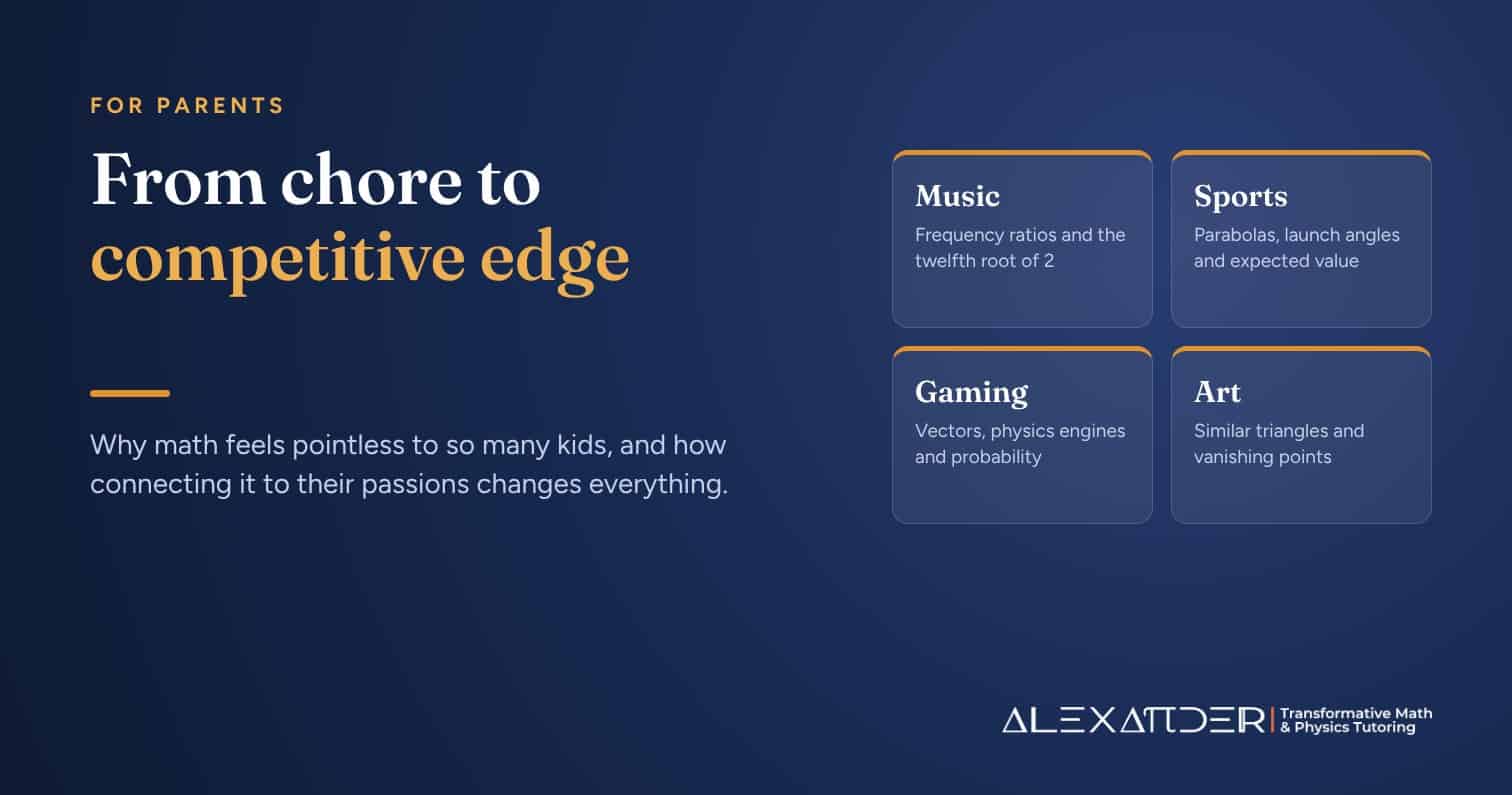
Our tutors keep a field guide of more than thirty passion connections. Here are a few favorites, with the class each one supports:
| Your child’s passion | The math inside it | Where it shows up in school |
|---|---|---|
| Basketball and baseball | Every shot and hit follows a parabola, and launch angle is trigonometry | Algebra 1, Precalculus, physics |
| Music | An octave is a 2:1 frequency ratio, and each half step multiplies by the twelfth root of 2 | Algebra 2, physics |
| Video games | A 1% loot drop gives only about a 63% chance of success in 100 tries | Algebra 2, Statistics |
| Baking | A 9-inch pan holds about 27% more batter than an 8-inch pan, because area grows with the square of the radius | Pre-algebra, Geometry |
| Skateboarding | Dropping in from 3 meters gives about 7.7 m/s at the bottom of the ramp | Algebra 1, physics |
| Art | Renaissance painters used similar triangles and vanishing points to create depth | Geometry |
| Saving money | At 7% growth, money doubles about every 10 years (the Rule of 72) | Algebra 1, Algebra 2 |
| Caffeine and health | Caffeine’s half-life is about 5 hours, so an afternoon coffee is still working at bedtime | Algebra 2, Chemistry |
| History | Alan Turing’s team used probability and logic to break the Enigma code | Algebra 2, Statistics |
Notice what happens in each one. The math is the same math your child sees in class. The difference is that now it has a reason to exist.
Tutor tip: Some famous “math in the real world” claims are myths, like golden rectangles hidden in the Mona Lisa. Our tutors sometimes test one of these claims with a student using real measurements. Being a skeptic with data is real mathematical thinking.
What can parents do at home this week?
The parent study above shows that your conversations matter more than you might think. A few simple habits help:
- Ask about the math in their hobby. “How do you think they figure out a player’s batting average?” is a better question than “Did you do your math homework?”
- Talk about purpose, not punishment. Connect math to careers and goals your child already has, not to grades alone.
- Retire “I was never a math person.” Kids borrow our stories about ourselves. Try “Math was hard for me, and I wish someone had shown me why it mattered.”
- Notice math out loud. Tips at dinner, sale prices, sports stats and recipe scaling are all chances to show math doing something useful.
- Get help early. If math has already turned into a battle, a tutor who can rebuild both skills and interest saves months of frustration. Our guide to sparking interest in STEM has more ideas.
Frequently asked questions
Why is math important for my child’s future?
Math is the gateway to many of the fastest growing, best paid careers. The U.S. Bureau of Labor Statistics projects STEM jobs to grow 8.1% from 2024 to 2034, about three times faster than other jobs, with a 2024 median wage of $103,580 versus $48,000. Strong math also opens doors in fields like medicine, finance and sports management.
Why does my child think math is pointless?
Usually because nobody has connected it to anything they care about. School math is often taught as a list of procedures with no reason attached. When a student sees the math inside something they love, like music, sports or video games, the question “when will I ever use this?” tends to disappear.
Does making math relevant really improve grades?
Research says yes. In a randomized study of 9th graders, students with low expectations who wrote about how class material applied to their lives raised their grades by about two thirds of a letter grade. In a separate trial, teens whose parents received materials about the value of math and science took nearly one more semester of those courses and scored about 12 percentile points higher on the ACT math and science sections.
What are some examples of math in real life for kids?
A basketball shot is a parabola. Music is built on frequency ratios. Video game loot drops are probability. Baking is ratios and scaling. Saving money is exponential growth. The best example is always the one tied to your child’s own interests.
How do your tutors connect math to my child’s interests?
In the first lesson, the tutor asks what your child loves to do. From then on, they use those interests to introduce new topics, then tie every example back to the skills on the next test. The passion opens the door, and the curriculum stays the destination.
Every student has a way in
Once your child sees their own passions in an equation, motivation stops being something you have to supply. It becomes something they bring. Every program starts with a risk-free first lesson, and you only pay if it’s the right fit. See plans and pricing.